

7 Ways Cognitive Behavioral Therapy Helps Autistic Children Handle Anxiety and Big Emotions
Cognitive behavioral therapy helps autistic children manage anxiety and big emotions using visuals, routines, and parent coaching. See ways to use CBT at home.

Key Points:
- Cognitive Behavioral Therapy helps autistic children manage anxiety and big emotions.
- This is achieved by teaching them to name feelings, reframe unhelpful thoughts, use calming techniques, and face fears in small steps.
- With visual supports, parent coaching, and routines, CBT builds emotional awareness and coping strategies that carry into daily life.
Big emotions can show up fast for autistic children. A small change in routine, a loud sound, or a confusing social moment can turn into panic, meltdowns, or shutdowns that leave everyone exhausted. Anxiety is very common in autism; one large review estimates that around 40% of autistic children meet criteria for at least one anxiety disorder.
Cognitive behavioral therapy (CBT) gives children and parents a clear, teachable way to understand those feelings and respond differently. When CBT is adapted for autism, cognitive behavioral therapy in autism care can help children manage worry, panic, and anger in more predictable and practical ways.
Below are seven concrete ways CBT benefits autistic children who live with anxiety and big emotions, with examples families can picture at home, in school, and in therapy.

1. Name Feelings So They Feel Less Scary
Anxiety often shows up in behavior before children have words for what they feel. Many autistic children notice stomach pain, a racing heart, or “wanting to run away,” but cannot label it as “nervous” or “afraid.” That gap can make emotions feel huge and out of control.
CBT starts by teaching the link between thoughts, feelings, and actions in very concrete ways, building emotional awareness in autistic children step by step. Therapists use visuals, simple stories, and autism-friendly tools such as emotion charts or color zones so children can point to what they feel.
Under this “naming” step, CBT benefits children by:
- Using visual supports: Emotion scales, pictures, or color zones help children match body signals to feeling words.
- Connecting body and brain: Simple phrases like “tight chest means worried” or “heavy body means sad” make internal states easier to spot.
- Reducing shame: When children see that big emotions are common and expected, they feel less “wrong” and more willing to talk.
Once a child can say “I feel worried” instead of just screaming or hiding, the rest of the CBT work becomes much easier to use.
2. How Does Cognitive Behavioral Therapy Break the Worry Cycle?
Anxiety in autism often follows a pattern: something triggers fear, a scary thought shows up, the body reacts, and the child avoids the situation. For many families, managing anxiety in autism starts with noticing that loop Avoidance brings short-term relief, so the brain learns, “I must avoid that again,” and the cycle keeps getting stronger.
Cognitive behavioral therapy breaks that cycle by teaching children to notice unhelpful thoughts and try more balanced ones. A recent trial with autistic children ages 7–13 found that more than 80% of those who received CBT were rated as much or very much improved, compared with about 11% of those who stayed in usual care.
To make the “worry cycle” easier to change, therapists often:
- Map the pattern: Use simple diagrams that show “trigger → thought → feeling → action → result.”
- Catch worry thoughts: Help children notice thoughts like “I will fail,” “Everyone will laugh,” or “I cannot do this.”
- Practice new thoughts: Replace all-or-nothing ideas with phrases like “I can try once,” or “I might need help, but I can start.”
When children see that a thought is just one possible story, not a fixed truth, they feel more able to try something different in the moment, even when anxiety disorders in autism have been present for a long time.
3. Use CBT Techniques To Calm the Body
Big emotions are easier to handle when the body feels calmer. Many autistic children feel anxiety first in their body: tight muscles, shallow breathing, sweaty hands, or a need to pace. CBT techniques give practical ways to shift those sensations so the brain can think again.
Helpful CBT techniques for calming the body can include:
- Slow breathing: Practice “smell the flower, blow the candle” or simple 4-count in and 4-count out breathing.
- Muscle relaxation: Gently tense and relax different muscle groups to release built-up tension.
- Grounding skills: Name five things you see, four you feel, three you hear, two you smell, and one you taste to bring attention back to the present.
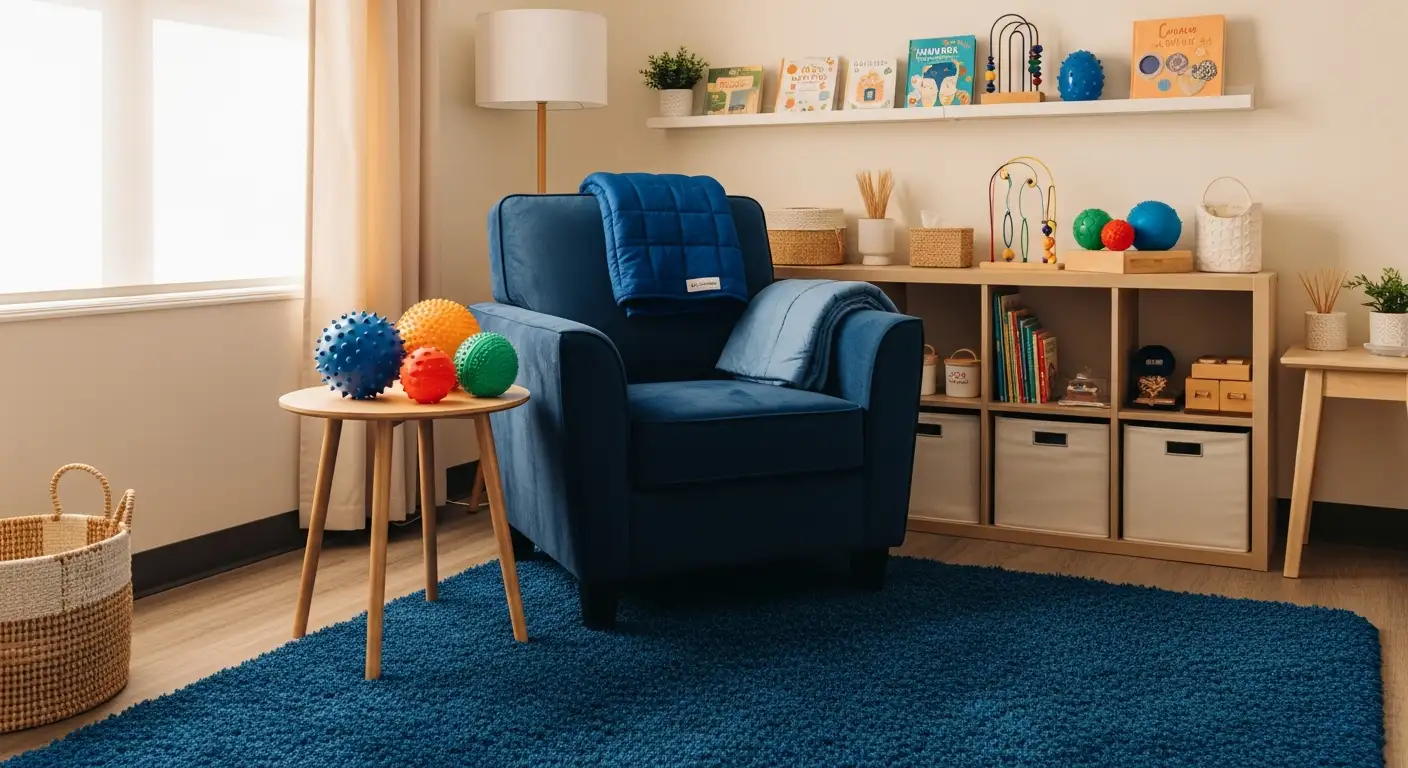
- Safe sensory choices: Build a menu of sensory breaks and tools (fidgets, weighted items, music) that match the child’s needs.
When these calming strategies are rehearsed during calm moments, children are more likely to use them during transitions, noise, or social stress.
4. Turn Avoidance Into Small, Brave Steps
Avoidance keeps anxiety strong. Autistic children may avoid dogs, school bathrooms, noisy cafeterias, or any situation linked to past meltdowns. Over time, life can shrink around those fears, and families may plan everything around avoiding triggers and autism-related behavioral challenges at home.
CBT uses gradual exposure to help children face fears in tiny, planned steps. For autistic children, exposure plans usually move more slowly, use clear visuals, and respect sensory needs and safety. A fear ladder might start with pictures or pretend play long before any real-life challenge.
Exposure-based CBT benefits autistic children by:
- Breaking goals into small steps: Start with the least scary version of the situation and move up only when the child is ready.
- Letting the child help design the plan: Choose which step comes next, which gives a sense of control.
- Pairing exposure with coping skills: Use practiced breathing, grounding, or scripts during each step.
- Celebrating effort, not perfection: Focus on “you stayed in the room for one more minute” rather than “you didn’t cry.”

5. Build Everyday Coping Routines at Home and School
One of the strongest CBT benefits is that skills are meant for daily life during in-home ABA therapy, not just the therapy room. For autistic children, anxiety often shows up around the same times and places: mornings, homework, community outings, or group activities at school.
Therapists and parents work together to build small “CBT routines” into those moments. The goal is to make coping automatic, like brushing teeth, instead of something special that only happens in sessions.
Practical ways to fold CBT techniques into daily routines include:
- Morning preview: Use a visual schedule plus one “If I feel worried, I will…” plan for the day.
- Transition scripts: Practice simple phrases for leaving preferred activities or moving between tasks.
- Homework coping station: Set up a quiet space with a timer, calm-down card, and movement break plan.
- Bedtime wind-down: Use the same breathing exercise, short check-in, and low-sensory setup every night to support an ABA bedtime plan for autism sleep problems.
When coping tools are built into familiar routines, children need less verbal prompting over time and feel more independent in managing their big emotions.
6. Coach Parents To Support Big Emotions
CBT works best when parents are part of the process, especially for autistic children who rely on trusted adults during tough moments. Parent participation lets families learn the same language, practice the same skills, and respond in more predictable ways.
Studies of CBT groups for autistic youth show that including parents leads to stronger gains and sustained improvements, partly because parents feel more able to coach their child through anxiety.
Parent-focused pieces of CBT often include:
- Learning the same concepts: Parents learn how thoughts, feelings, and behaviors link together, so coaching feels consistent.
- Using calm coaching scripts: Simple scripts like “Name it, breathe, choose” help parents respond the same way each time.
- Adjusting home expectations: Families learn when to lower demands temporarily and when to gently hold a boundary.
- Tracking progress together: Parents and therapists review small wins, triggers, and strong days or tough days.
When parents feel equipped, children sense that adults are steady and predictable, which lowers anxiety and makes outbursts less intense over time.

7. Help Skills Carry Over Into New Situations
Many autistic children can use coping tools in one setting but lose them in new places, such as a new classroom, a relative’s house, or a busy clinic. Cognitive behavioral therapy addresses generalization by planning for new settings from the start.
Virtual and group CBT programs for autistic youth show that when children practice across different settings and with different adults, anxiety drops and skills carry over more easily. This is especially helpful for families using a mix of in-home ABA, school supports, and community activities.
To support carryover, therapists and families can:
- Practice in varied settings: Use coping skills in the living room, backyard, car, and community spots that feel safe enough.
- Change one thing at a time: Shift location, time of day, or adult partner gradually rather than all at once.
- Create “traveling” visual supports: Bring portable cards, small schedules, or pictures that remind children of their tools.
- Loop in school teams: Share simple scripts and visuals with teachers or aides to keep responses consistent.
When CBT skills follow the child into new environments, anxiety becomes more manageable in real life, not just in therapy notes.
FAQs About Cognitive Behavioral Therapy
Is CBT safe for autistic children who have very intense meltdowns?
Yes, CBT is safe for autistic children with intense meltdowns when adapted properly. Therapists focus on safety, move at the child’s pace, and adjust activities to fit communication and sensory needs. CBT aims to reduce distress without pushing beyond the child’s limits.
How long does CBT usually take for anxiety in autistic children?
CBT for anxiety in autistic children usually takes 10 to 16 weekly sessions. Some families add booster sessions or use CBT tools within ongoing therapy to maintain progress. Duration depends on the child’s needs and how well skills are practiced between visits.
Can parents use CBT strategies at home without a therapist?
Yes, parents can use CBT strategies at home without a therapist. Tools like emotion charts, breathing exercises, and thought–feeling–action maps support regulation. A trained therapist can still help adapt these tools for autism and coordinate them with other therapies for better results.
Get Support for Your Child’s Anxiety
Anxiety and big emotions can shape a child’s whole day, from waking up to falling asleep. When CBT techniques are woven into autism therapy services in New Mexico, Colorado, Utah, North Carolina, Maryland, and Nebraska, families gain everyday tools for naming emotions, calming the body, and facing tough moments step by step.
At Attentive Autism Care, therapists focus on practical, home-based strategies that fit real family routines and respect each child’s sensory and communication needs. Cognitive and behavioral tools are built into in-home ABA sessions so skills grow where children live, learn, and play.
If your child’s worry or meltdowns are starting to take over family life, reach out to us. You can ask about assessment, talk through goals, and see how CBT-style anxiety support can be layered into your child’s ABA plan so home, school, and community days feel more manageable.




























































































Attentive Autism Care delivers compassionate, home-based ABA therapy, offering personalized support to help children with autism thrive and achieve their best.
